Padel is the fastest-growing racket sport in the world — but if you’ve never played, you’re probably wondering how it compares to tennis. Having played both sports regularly at UK courts, we can tell you the differences go deeper than just the walls. They share some DNA, but the differences are what make padel so addictive. Here’s everything you need to know.
The Short Answer
Padel is played on a smaller, enclosed court with solid walls (like squash meets tennis), using a solid stringless racket and a depressurised ball. It’s always doubles, scoring is identical to tennis, and the walls are in play — meaning rallies last longer and the game is far more accessible to beginners.
Tennis is played on a larger open court with a strung racket and pressurised ball. It can be singles or doubles, requires more power and athleticism, and has a steeper learning curve.
Court Size & Layout
This is the most obvious difference and the one that changes everything about how the game plays.
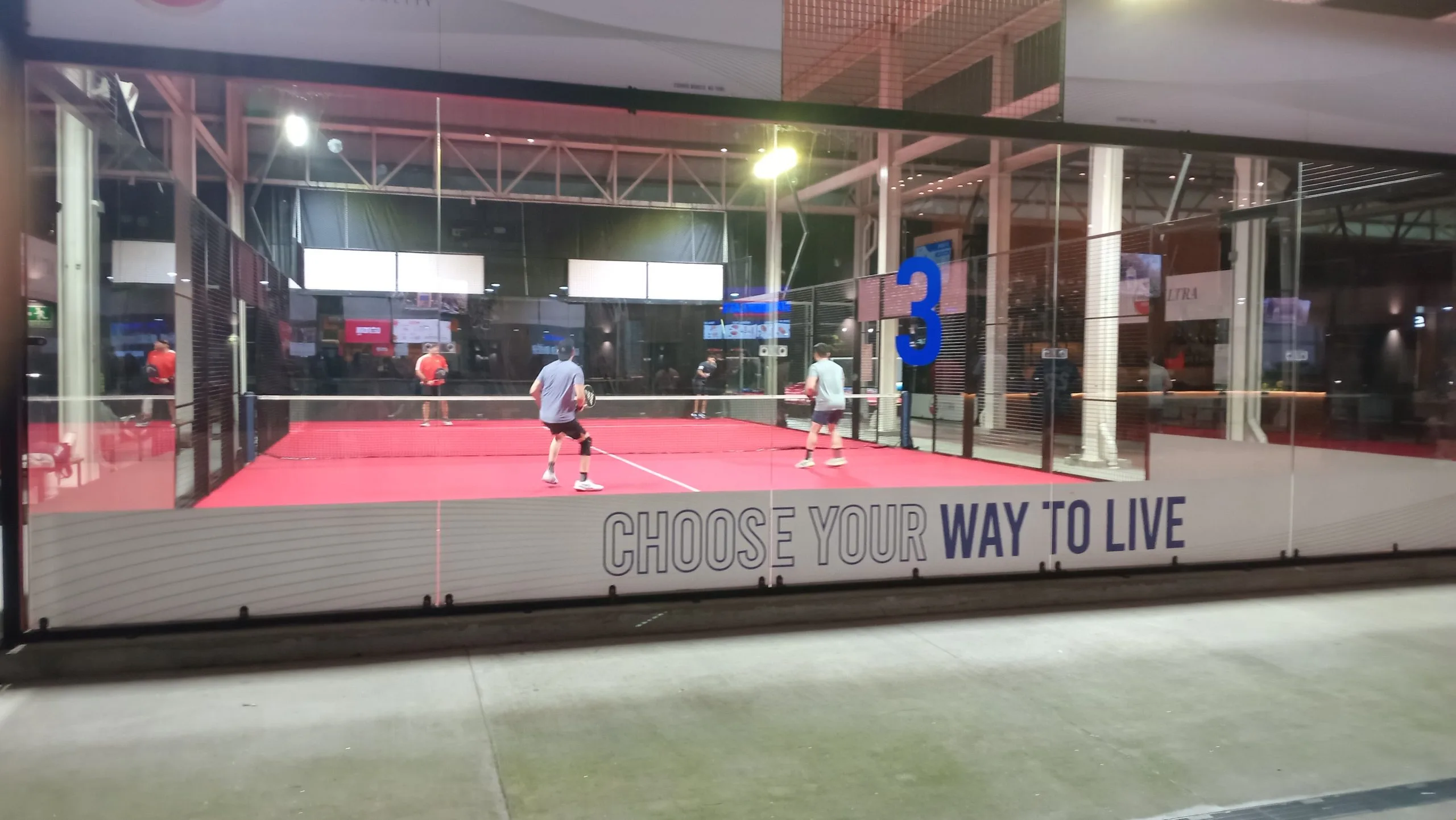
- Padel court: 20m × 10m (roughly one-third the size of a tennis court), fully enclosed by glass walls and metal fencing. The back walls are 3m high glass; the side walls are a mix of glass and mesh.
- Tennis court: 23.77m × 10.97m (doubles) or 23.77m × 8.23m (singles). Open on all sides — the ball is out if it leaves the court.
The enclosed court is what makes padel unique. Balls can be played off the walls after bouncing, similar to squash. This keeps rallies alive longer, creates unexpected angles, and means you spend less time chasing balls into the next court.
The Rackets
Padel and tennis rackets look completely different — and they play completely differently too.
- Padel racket: Solid face (no strings) with a foam core, perforated with small holes. Shorter than a tennis racket at around 45-46cm. Attached wrist strap is mandatory. Weight typically 340-380g.
- Tennis racket: Strung face with a larger head, longer handle (68-71cm total length). Weight varies from 260-340g depending on style.
The solid padel racket produces less power but more control. You don’t need a big swing — the game rewards placement, touch, and tactical shot selection over raw power. This is one reason padel is so beginner-friendly: you can play competent shots from day one without months of technique work.
The Ball
They look identical, but padel balls have slightly less internal pressure than tennis balls. This means they bounce lower and slower, giving players more time to react and keeping the ball in play longer.
In practice, you can use tennis balls for casual padel — but official padel balls (from brands like Head, Bullpadel, and Wilson) are tuned for the smaller court and wall play.
Scoring & Rules
If you know tennis scoring, you already know padel scoring — they’re identical.
- Points: 15, 30, 40, game
- Deuce and advantage: Same as tennis
- Sets: First to 6 games (with tiebreak at 6-6)
- Match: Best of 3 sets
The key rule differences are:
- Always doubles. Padel is exclusively a doubles game. There’s no singles padel (well, there are experimental single-court formats, but they’re rare).
- Underarm serve only. You must serve underarm, hitting the ball at or below waist height. No overhead smashes on the serve — this levels the playing field enormously.
- Walls are in play. After the ball bounces on your side, it can hit the back or side wall and you can still return it. You can even hit the ball off your own side wall to get it over the net.
- You can leave the court. In padel, if the ball bounces on your side and goes over the back wall or side fencing, you can run out of the court through the side doors to play it. This creates some of the most spectacular points in the sport.
Playing Style & Strategy
This is where the two sports really diverge.
Tennis rewards power, athleticism, and individual brilliance. The serve is the most dominant shot in the game. Baseline rallies involve heavy topspin and pace. Singles tennis is essentially a 1v1 battle of movement, power, and endurance.
Padel rewards positioning, patience, and teamwork. Because the court is enclosed, power alone doesn’t win points — your opponent can retrieve powerful shots off the wall. Instead, the game is about:
- Net control: The team that controls the net position wins most points. Moving forward together as a pair is fundamental.
- Lobs and placement: Pushing opponents back with high lobs, then attacking when they’re out of position.
- Wall play: Using the walls to create angles and retrieve seemingly impossible shots.
- Communication: Doubles requires constant coordination — who takes the middle ball, when to switch sides, when to advance.
Fitness & Physical Demands
Both sports will give you a workout, but the demands are different.
- Tennis: Covers a much larger court. Singles tennis involves huge amounts of lateral movement, sprinting, and endurance. A competitive singles match can burn 400-600 calories per hour. High impact on shoulders (serving) and knees.
- Padel: Smaller court means less running but more explosive short movements. A typical padel session burns 300-500 calories per hour. Lower impact on joints — the underarm serve is far gentler on the shoulder than a tennis serve. Games typically last 60-90 minutes.
For people who find tennis physically demanding or are coming back from injury, padel offers a genuinely competitive racket sport without the same physical toll. It’s one reason the sport is popular with players in their 40s, 50s, and beyond.
Learning Curve
This is padel’s secret weapon.
Tennis has a notoriously steep learning curve. Getting a consistent serve, developing topspin groundstrokes, and learning to volley takes months or years of practice. Many beginners spend their first lessons just trying to get the ball over the net consistently.
Padel is playable from your very first session. The smaller court, solid racket, slower ball, and underarm serve mean that complete beginners can have fun rallies within 30 minutes. The walls keep the ball in play, so you spend less time picking up balls and more time actually playing. For a related angle, see our Padel Shoes vs Tennis Shoes: Can You Use Tennis Shoes? guide.
That said, the skill ceiling in padel is extremely high. Professional padel players demonstrate incredible touch, tactical awareness, and shot variety. Easy to learn, difficult to master — which is the hallmark of a great sport.
Cost to Play in the UK
Here’s a realistic comparison for UK players in 2026:
- Padel court hire: £10-20 per person per hour (courts are always booked by the hour for 4 players)
- Tennis court hire: £5-15 per person per hour (or free/included with club membership)
- Padel racket: £50-200 for a decent beginner-to-intermediate racket
- Tennis racket: £40-150 for a similar level
- Balls: £5-8 for a tube of 3 (both sports)
Padel is slightly more expensive per session because court availability is still limited in the UK — but as more courts open (there are now over 400 padel courts in the UK, with hundreds more planned), prices are becoming more competitive.
Availability in the UK
Tennis has a massive head start. There are around 23,000 tennis courts in the UK, plus thousands of public park courts. You can play tennis almost anywhere.
Padel is catching up fast. From just a handful of courts in 2019, the UK now has over 400 padel courts — with major chains like Game4Padel, Padel Social Club, and We Are Padel expanding rapidly. The LTA (Lawn Tennis Association) has invested heavily in padel, converting existing tennis facilities and building dedicated padel centres.
If you live in or near a major UK city, there’s almost definitely a padel court within driving distance. Rural areas are still catching up, but the expansion is accelerating.
Social Factor
This is often underrated but it’s a huge part of padel’s appeal.
Tennis singles can be an intense, solitary experience. Doubles tennis is more social but finding four players of similar ability isn’t always easy.
Padel is inherently social — you always need four players, the court is small enough for conversation during play, and the skill gap between beginners and intermediates is smaller. It’s common for padel sessions to include mixed abilities without anyone feeling left out. Many padel clubs run social sessions, mixers, and leagues specifically designed to help players find regular groups. Our Best Padel Rackets for Intermediate Players 2026 guide is useful alongside this.
Which Should You Play?
Choose padel if:
- You want a social, doubles-focused sport
- You’re a complete beginner and want to have fun quickly
- You’re coming back from injury or want lower-impact exercise
- You enjoy tactical, placement-based play over power
- You want something new and different
Choose tennis if:
- You enjoy singles competition and individual challenge
- You want maximum physical workout and court coverage
- You prefer a sport with decades of local club infrastructure
- You enjoy the satisfaction of developing complex technique over time
Or play both. Many padel players also play tennis (and vice versa). The skills transfer well — good hand-eye coordination, court awareness, and competitive instinct serve you in both sports. Andy Murray plays padel. Rafael Nadal owns padel clubs. If it’s good enough for them, it’s good enough for the rest of us.
Transitioning Between Sports: What Transfers and What Doesn’t
If you already play tennis, switching to padel is easier than you might expect — but a few ingrained habits will trip you up at first. Understanding what transfers and what needs unlearning saves weeks of frustration on court.
What transfers well: Court awareness, anticipation, and reading your opponent’s body language all carry over directly. If you can read a tennis player’s serve toss, you can read a padel player’s lob setup. Net play translates beautifully — the volleying skills you’ve developed in tennis doubles become your biggest weapon in padel. Footwork fundamentals also transfer, particularly the split step and recovery movements that keep you balanced and ready.
What you need to unlearn: The biggest adjustment is power. Tennis rewards big swings and aggressive hitting. Padel punishes them. Those flat groundstrokes that win points in tennis? They’ll fly into the back glass and set your opponents up for an easy volley. The padel swing is shorter, more compact, and focused on placement rather than pace. Most tennis players spend their first few padel sessions hitting everything too hard. We cover a similar decision in Best Padel Shoes 2026 UK: Grip & Comfort Tested.
The serve is another major reset. Tennis players have spent years perfecting an overhead serve with spin and power. In padel, the serve must be underarm and hit at or below waist height. It feels wrong at first — almost embarrassingly gentle — but the underarm serve is actually a tactical weapon once you learn to place it accurately. Slice serves that hug the glass are far more effective than pace.
Going the other way — padel to tennis: If padel is your first racket sport and you decide to try tennis afterwards, expect a steeper learning curve. The strung racket behaves completely differently from a solid padel bat — the sweet spot is smaller, mishits are more punishing, and generating topspin requires technique that takes months to develop. However, your net instincts and tactical awareness from padel will put you ahead of complete beginners.
Many UK clubs now offer both sports, making it easy to play tennis on Tuesday and padel on Thursday without changing venue. The LTA actively promotes padel alongside tennis, and dual-sport membership packages are becoming increasingly common at clubs across the country.
The ideal approach? Don’t choose between them too quickly. Play both for a few months and see which one you look forward to more. The sport that gets you out of bed on a Saturday morning is the right one — regardless of what the internet tells you.
Fitness Benefits: Padel vs Tennis
Both padel and tennis are excellent for fitness, but they work your body in different ways. Understanding these differences can help you choose the right sport for your fitness goals — or convince you to play both.
Tennis is the higher-intensity option. A typical hour of singles tennis burns 400-600 calories, involves covering 3-5km of ground, and demands explosive sprinting, stopping, and direction changes. The serve alone engages your legs, core, shoulder, and arm in a powerful kinetic chain. It’s excellent for cardiovascular fitness, leg strength, and agility — but the repeated overhead motion and hard stops can be tough on shoulders, knees, and ankles over time.
Padel burns roughly 300-500 calories per hour of doubles play. The shorter court means less running, but the constant movement, wall play, and net approaches keep your heart rate elevated throughout. The underarm serve removes the shoulder stress that tennis players commonly suffer from, and the enclosed court means fewer sudden sprints to retrieve wide balls. According to the NHS physical activity guidelines, adults need 150 minutes of moderate activity per week — two padel sessions comfortably covers that.
Padel is particularly strong for core fitness. The rotational movements in volleys and wall shots engage your obliques and deep core muscles in ways that running or cycling don’t. Many players report improved balance and coordination after a few months of regular play. For players over 40 or those returning from injury, padel offers a really competitive workout with lower joint impact than tennis.
The Bottom Line
Padel isn’t trying to replace tennis — it’s offering something different. A faster-to-learn, more social, lower-impact racket sport that happens to be incredibly fun. The UK is in the early stages of a padel boom, and there’s never been a better time to try it.
Find your nearest court, grab three friends, and book an hour. You’ll understand the hype within the first 10 minutes. When you’re ready to buy your own racket, our beginner rackets guide will help you choose, and our racket shapes explainer will help you understand the different options.
Frequently Asked Questions
What kit do you need to start playing padel? You need a suitable racket, court shoes, balls and comfortable sports clothing. A bag, overgrips and accessories can come later.
Is padel beginner-friendly? Yes. The underarm serve, smaller court and doubles format make it easier to start than many racket sports.
How do you avoid wasting money on padel gear? Buy for your current level and local court surface. Comfort and control matter more than premium power features early on.
What should I check first with Padel vs Tennis: Key Differences Explained? Start with the real use case, then check size, compatibility, running costs and maintenance. A product that looks good on paper can still be the wrong fit if it does not suit the room, routine or budget.
How do I avoid wasting money on Padel vs Tennis: Key Differences Explained? Avoid buying on one headline feature alone. Compare the practical details, read the warranty or returns terms, and choose the option that solves your main problem rather than the one with the longest specification list.