You’ve played padel every week for a year, you’re hooked, and the thought has crept in — what would it cost to build a court at home? Or maybe you’re a club owner looking to add courts, or a property developer exploring the business case. Either way, the answer is more complex than a single number. A padel court involves structural engineering, specialist glass, artificial turf, drainage, lighting, and planning permission considerations that push the project well beyond “it’s just a fenced area with a net.”
In This Article
- What Goes Into a Padel Court?
- Total Cost Breakdown
- Court Surface Options and Costs
- Glass Walls and Metalwork
- Foundations and Groundwork
- Lighting
- Indoor vs Outdoor Courts
- Planning Permission in the UK
- Ongoing Costs and Maintenance
- Is Building a Court Worth It?
- Frequently Asked Questions
What Goes Into a Padel Court?
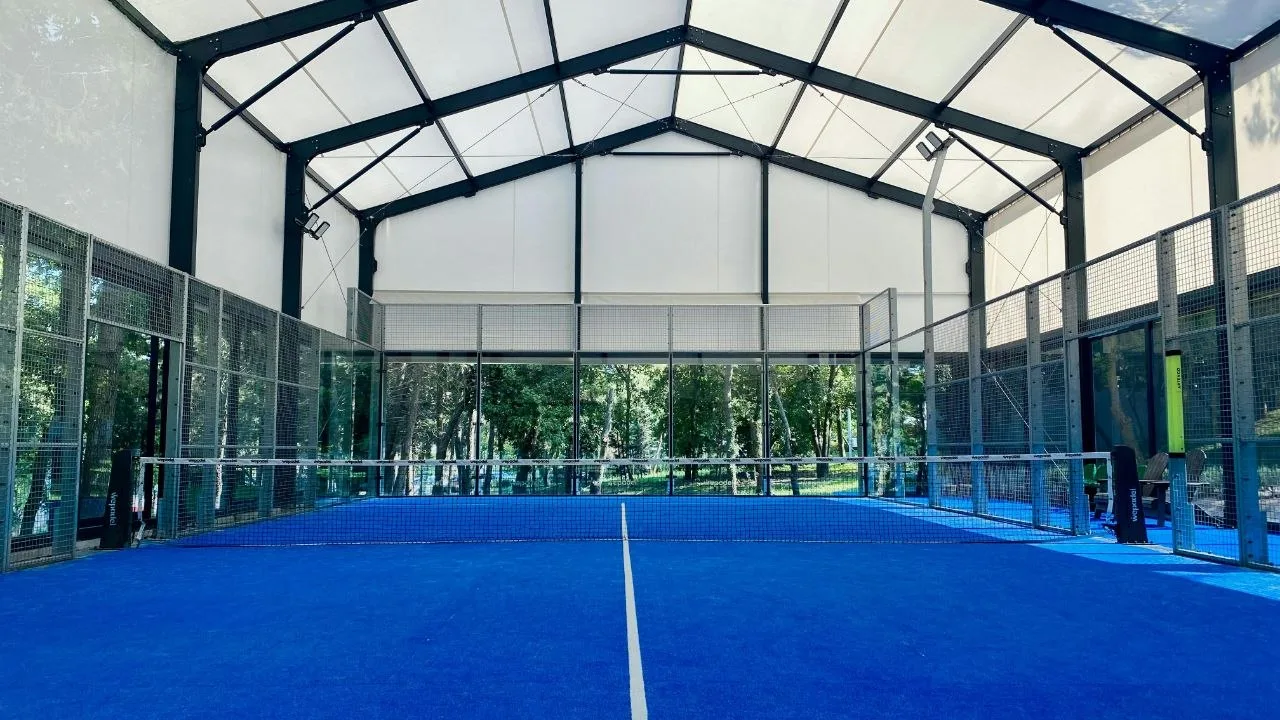
A standard padel court is 20m × 10m (200 square metres) with specific structural requirements set by the International Padel Federation (FIP).
The Key Components
- Foundations — reinforced concrete base capable of supporting glass walls and withstanding ground movement
- Structural steelwork — the frame that holds the glass panels and mesh fencing
- Glass walls — tempered glass panels (10-12mm thick) on the back walls and partial side walls
- Mesh fencing — galvanised steel mesh completing the enclosure above the glass
- Playing surface — artificial turf with sand infill, designed specifically for padel
- Net and posts — regulation-height net (88cm centre, 92cm posts) with tensioning system
- Lighting — floodlights for evening play (essential in the UK where daylight limits play for 6+ months)
- Drainage — critical for outdoor courts in the UK climate
Why It’s Not a DIY Project
Every component needs to meet FIP specifications for competitive play, and even for recreational use, the structural requirements (glass wall retention, wind loading, drainage capacity) require professional engineering. This isn’t a garden fence and some artificial grass — it’s a structural build that needs proper foundations, certified materials, and specialist installation.
Total Cost Breakdown
Single Outdoor Court
- Budget (basic specification): £35,000-50,000
- Mid-range (good quality, meets FIP standards): £50,000-75,000
- Premium (tournament-grade, top materials): £75,000-120,000
What’s Included at Each Level
Budget (£35,000-50,000):
- Concrete slab foundation
- Standard structural steel (galvanised)
- 10mm tempered glass walls
- Basic artificial turf surface
- Standard mesh fencing
- No lighting (add £5,000-10,000)
- Basic drainage
Mid-range (£50,000-75,000):
- Engineered reinforced foundation with proper drainage integration
- Powder-coated structural steel
- 12mm tempered glass walls (FIP approved)
- Premium artificial turf with correct sand infill depth
- Heavy-gauge mesh with wind resistance
- LED floodlighting included
- Full drainage system with soakaway
Premium (£75,000-120,000):
- Over-engineered foundations for any ground condition
- Stainless steel or marine-grade structure
- Tournament-grade glass with anti-reflection coating
- Top-tier artificial turf (Mondo, Poligras)
- Integrated LED lighting system with dimming
- Full drainage with connection to storm water system
- Player benches, scoreboard, and spectator area
Indoor Court Premium
Building a padel court inside an existing building (warehouse, sports hall) saves on foundations and weatherproofing but adds structural considerations:
- Minimum ceiling height: 8 metres (FIP requirement for competitive play, 7m minimum for recreational)
- Conversion cost: £40,000-80,000 depending on existing structure
- New build hall housing 2-4 courts: £200,000-500,000+
Court Surface Options and Costs
Artificial Turf (Standard)
The default padel court surface worldwide. Short-pile synthetic turf (typically 12-15mm) with silica sand infill that provides the characteristic slide-and-grip feel.
- Cost: £8,000-15,000 per court (supply and installation)
- Lifespan: 5-8 years depending on usage intensity
- Maintenance: Brush regularly to redistribute sand, remove debris, treat for moss/algae in UK climate
- Colours: Blue and green are standard. Other colours available at premium
Premium Surfaces
- Mondo Supercourt — the surface used in major tournaments. About £15,000-20,000 per court. Superior ball bounce consistency and player comfort
- Poligras Padel — German-engineered turf with excellent drainage. About £12,000-18,000
Replacement Costs
Surface replacement is the single biggest recurring expense. Budget £10,000-15,000 every 6-8 years. High-use commercial courts may need replacement every 4-5 years.
Glass Walls and Metalwork
Glass Specifications
Padel court glass takes serious punishment — balls travelling at 100+ km/h and players slamming into walls during play. The glass must be toughened (tempered) safety glass that shatters into small, relatively harmless pieces if broken.
- 10mm tempered glass — minimum for recreational courts. Adequate for club use but can crack under extreme impact. About £3,000-5,000 per court for all glass panels
- 12mm tempered glass — FIP standard for competitive play. More resistant to impact. About £5,000-8,000 per court
- Laminated tempered glass — two layers bonded together. Doesn’t shatter completely if broken, which is safer but costs £8,000-12,000
Replacement Glass
Individual panels crack eventually — it’s inevitable with regular competitive play. Replacement panels cost £300-600 each depending on thickness and size. Budget for 1-2 panel replacements per year on a well-used court.
Structural Steelwork
The steel frame holds everything together — glass panels, mesh fencing, net posts, and lighting. Quality matters:
- Galvanised steel — standard protection against rust. Adequate for indoor courts and covered outdoor courts. About £8,000-12,000
- Powder-coated steel — better appearance and corrosion resistance. Recommended for outdoor UK courts. About £10,000-15,000
- Stainless steel — maximum corrosion resistance for coastal locations. About £15,000-25,000
Foundations and Groundwork
Foundation Types
- Standard concrete slab — 150mm reinforced concrete with steel mesh. Suitable for stable, well-drained ground. About £5,000-8,000
- Engineered slab with piling — required on clay soil, waterlogged ground, or sloped sites. Piles driven to stable ground support the slab. About £10,000-20,000
- Drainage-integrated base — the foundation incorporates the drainage system, with falls built into the slab directing water to collection points. About £8,000-15,000
Site Preparation
Before the foundation goes in, the ground needs preparing:
- Topsoil strip and levelling — £2,000-5,000 depending on site conditions
- Tree removal — if required, £500-2,000 per tree (plus potential ecological surveys)
- Access road — crane or lorry access for delivering steel and glass. Temporary access routes: £1,000-3,000
The UK Ground Challenge
Much of the UK sits on clay soil, which swells when wet and shrinks when dry. This movement can crack a standard concrete slab within 2-3 years. If your site has clay soil (check by digging 300mm down — grey, sticky, forms a ball in your hand), you need an engineered foundation. Skipping this saves £5,000 upfront but costs £15,000+ when the court cracks.
Lighting
Why Lighting Is Essential in the UK
Between October and March, daylight ends before 5pm. Without floodlights, your court is unusable for evening play — which is when most people actually want to play. Lighting isn’t optional in the UK; it’s a core cost.
Lighting Options
- Metal halide floodlights — older technology, adequate but energy-hungry. About £3,000-5,000 installed. Running cost: roughly £2-3 per hour
- LED floodlights — current standard. Lower energy consumption, instant on/off, longer lifespan. About £5,000-10,000 installed. Running cost: roughly £0.80-1.50 per hour
- Integrated LED systems — built into the court structure, uniform light distribution, dimmable. About £8,000-15,000. The best playing experience
Light Level Requirements
FIP recommends a minimum of 400 lux for recreational play and 750+ lux for competitive/televised play. Most LED installations achieve 500-600 lux, which is comfortable for club-level padel.
Indoor vs Outdoor Courts
Outdoor Courts
- Lower build cost — no building required, just the court structure
- Planning permission — may be required depending on location and scale
- Weather exposure — UK rain affects play 100+ days per year. Wind impacts ball flight and player comfort
- Seasonal limitations — cold, wet, and dark conditions reduce winter usage
- Covering option — a tensile fabric canopy (£20,000-40,000) protects from rain while keeping the outdoor feel
Indoor Courts
- Higher build cost — the building itself costs more than the court
- Year-round use — weather-independent. This is the biggest advantage in the UK climate
- Planning permission — very likely required for a new building
- Temperature control — heating in winter, ventilation in summer. Running costs increase
- Commercial viability — indoor courts generate 50-100% more revenue than outdoor due to year-round bookability
The UK Climate Factor
An outdoor padel court in the UK loses roughly 30-40% of potential playing hours to weather (rain, high wind, poor visibility). An indoor or covered court eliminates this entirely. For commercial operations, the higher build cost of indoor courts is recovered through year-round revenue. For private courts, the question is whether you’ll actually play enough in winter to justify the additional investment. For a related angle, see our Compression Clothing for Padel: Worth It? guide.
Planning Permission in the UK
When You Need It
Planning permission requirements vary by local authority, but general guidance from gov.uk:
- Single court in a large garden — may fall under permitted development if the structure doesn’t exceed 4m height and is not in a conservation area. Check with your local planning department
- Multiple courts — almost always requires planning permission due to scale, noise impact, and traffic generation
- Commercial courts — requires planning permission, potentially change of use application, and possibly an Environmental Impact Assessment for larger developments
- Listed buildings or conservation areas — planning permission required regardless of scale
Noise Considerations
Padel courts generate noise — ball impacts on glass, player calls, and court lighting hum. Neighbours may object. Planning applications for courts near residential areas typically require a noise assessment. Glass wall construction actually helps — the enclosed court contains noise better than an open tennis court.
Light Pollution
Floodlighting must comply with local lighting policies. Most councils restrict upward light spill and require shielded luminaires. LED systems with precise beam control are easier to get approved than older floodlight types.
Ongoing Costs and Maintenance
Annual Maintenance Budget
- Surface maintenance (brushing, moss treatment, sand top-up) — £500-1,000/year
- Glass panel inspection and cleaning — £300-500/year
- Structural inspection (steelwork, fixings, mesh) — £200-400/year
- Lighting maintenance (lamp replacement, alignment) — £200-500/year
- Drainage maintenance (clearing, inspection) — £200-400/year
- Net replacement — about £150-300 every 1-2 years
Total Annual Maintenance
Budget approximately £1,500-3,000 per year for a well-maintained outdoor court. Indoor courts cost slightly less (no moss, less weather damage) but require building maintenance on top.
For finding courts to play on before committing to building your own, that guide covers booking apps and locations across the UK. And understanding court dimensions in detail helps you assess whether your space can accommodate a full-size court.
Is Building a Court Worth It?
For Private Use
A padel court costs £50,000-80,000 to build and £2,000-3,000/year to maintain. Compare this to playing at a club: £20-40 per hour, 3 times per week, 48 weeks per year = £2,880-5,760/year. At the higher rate, a private court pays for itself in 10-15 years of club fee savings — but only if you play that frequently. For most individuals, club membership and pay-per-play is more economical unless you play almost daily and have the garden space. Our How to Choose a Padel Racket: Shape, Weight & Material guide is useful alongside this.
For Commercial Operations
The business case is stronger. A single court generating 40 bookable hours per week at £30/hour produces £1,200/week gross revenue. With 70% utilisation (realistic for a popular location), that’s £840/week or about £43,000/year. Against a build cost of £70,000 and annual costs of £5,000, a single court can pay back in 2-3 years. Two or more courts improve the economics further through shared infrastructure costs.
The Growth Factor
Padel is the fastest-growing sport in the UK. Court demand currently outstrips supply in most areas, which supports both the commercial case and the potential property value benefit of having a court. Whether this growth continues at the current rate is uncertain — but the current trajectory strongly favours investment.
Frequently Asked Questions
How much does a padel court cost to build in the UK? A single outdoor padel court costs £35,000-75,000 depending on specification, with mid-range FIP-compliant courts averaging £50,000-65,000. Indoor courts cost more due to the building requirement — expect £80,000-150,000+ including the structure. Add £5,000-10,000 for lighting if not included.
How big is a padel court? A regulation padel court is 20 metres long and 10 metres wide (200 square metres playing area). Including the surrounding clearance needed for structure, access, and safety, plan for a minimum footprint of 24m × 14m (336 square metres) of available space.
Do I need planning permission for a padel court? Possibly. A single court in a large garden may fall under permitted development, but this depends on height, location, and local planning policies. Commercial courts, multiple courts, and any court in a conservation area will require planning permission. Always check with your local planning authority before committing to the project.
How long does it take to build a padel court? A standard outdoor court takes 4-8 weeks from groundwork to completion, assuming foundations are uncomplicated and materials are available. Indoor court installations within existing buildings take 3-6 weeks. New building construction for indoor courts extends the timeline to 3-6 months.
How long does a padel court last? The steel structure and glass walls last 20-30 years with proper maintenance. The playing surface needs replacement every 5-8 years (the single biggest recurring cost). Lighting lasts 10-15 years for LED systems. Overall, a well-maintained court has a 20+ year lifespan with periodic component replacement.